Tuesday, 6 February 2018

Nanjing part 7 - Sun Yat-sen Mausoleum and other bits of Nanjing

Sun Yat-sen Mausoleum

 Dr Sun Yat-sen is a tremendously significant individual connected with "modern" China he was the first president and founding father of the Republic of China. He was born in what is now Zhongshan City (there is a very good memorial there) in 1866 with a cultural backgrounding Hakka and Cantonese. I would highly recommend reading the Wikipedia reference above.

Although he died in Beijing he is laid to rest in Nanjing the old Capital.

Lulled into a false sense of security one is suddenly confronted with the thing that characterises so many Chines monuments - the death of a thousand steps - pretty tough on my ancient western knees and beyond the reach of all but the most determined of older seniors.

It did strike me as odd that there should be such a grandiose display for a person who was instrumental in the downfall of the Qing Dynasty and the excesses that represented to the common person.


Views from the Guangzhou to Nanjing fast train
(six hours roughly with a lot of stops).


 Others


View from our hotel overlooking the Yangtze River with an elevated cycleway in the foreground and illuminated sculpture in the centre.


I can't remember where this was but I was really taken with the intricate design in a glazed piece.


Nanjing part 6 Presidential Palace


Presidential Palace.

The  Presidential Palace housed the President of the Republic of China from 1927 until 1949 and is now a museum to that time. Its origins date to the Ming period but the buildings were torched by the the Qing who rebuilt it as a Place in 1870.

When Sun Yat-sen was the President of the Republic of China he kept offices here for a time, They became the Headquarters of the Nationalist Government of the Republic of China and Premier Chiang Kai-shek had his offices here. After the Chinese civil war  Chiang Kai-sheks government fled to Taiwan and Mao Zedong declared the establishment of the People Republic of China with Beijing as its capital - the building there-after used for the local provincial government.

Which ever way you look at it its a series of buildings and gardens of significant recent historical interest.

We were there late in the day and it wasn't too busy but I'm certain this would be a very popular attraction.


Overall this is a stunning attraction with preservation (or reconstructions) of many areas as occupied at various times including the stable and music rooms (below).


This "House of Government fears was built in 1925 


Nanjing Part 5 - Chaotian Palace


The Chaotian Palace Wikipedia is centrally located in Nanjing on the Ye Mountain once a place of metal casting . The original buildings were burnt down during the Taiping Rebellion in the Qing Dynasty and the present Palace was built in 1866.


We were there in October latter in the day and almost had the place to ourselves although I have seen photos of hordes of people queuing up for this attraction - which pretty much reinforced everything I'd learnt about being a tourist in China which is avoid weekends, public holidays and school holidays and spring, autumn and winter are best.


I found this place a very pleasantly photogenic ramble with manicured gardens, areas a little overgrown and in a good state of repair.


The constant maintenance these building require 


Nanjing Part 4 - Eating areas and Xuanwuhu Park


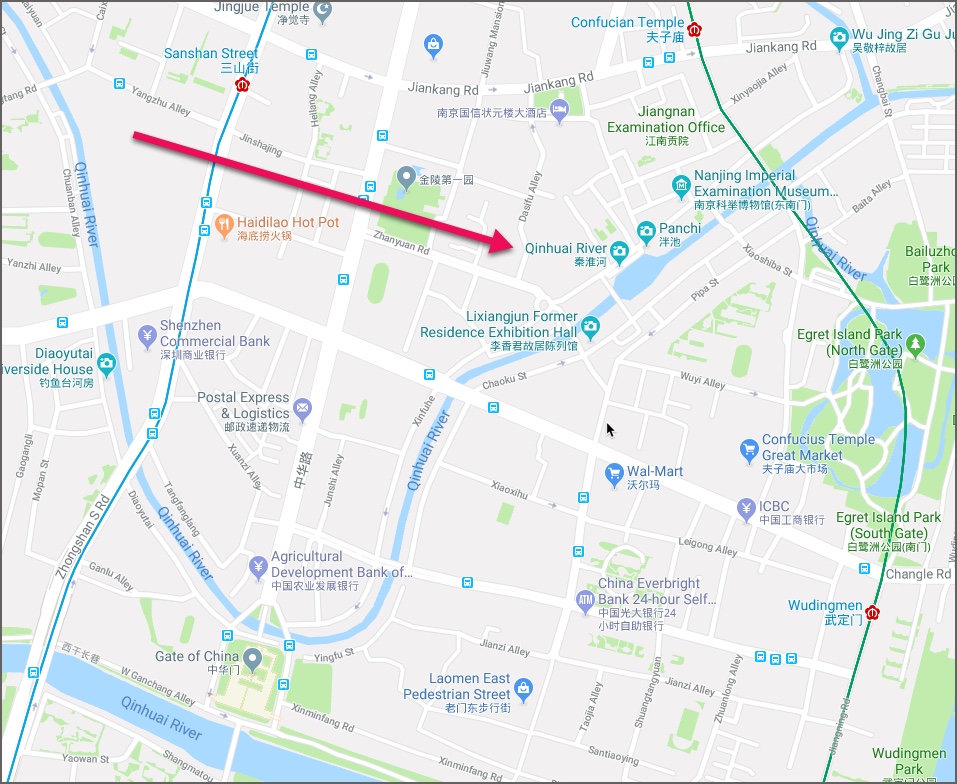
Well worth a visit (at night) is the Xinhua River in the area shown on the map below - take the boat ride.  There is also a large area dedicated to eating adjacent , we ate there twice on our short trip.


Entrance to eating area 


Xuanwuhu Park

The city wall runs along the west and southern sides of Xuanwu Lake with one of its spectacular gates as the entrance to a small park/ island in the middle.


You can rent the small electric boats above which are easy to drive but move at a pretty glacial pace, I have my serious doubts they could make much progress into a decent head wind. 

On the day we were there there were few out so we had no difficulty navigating around without hitting anyone or being hit by unaccustomed boat drivers. 

A very relaxing way to spend the last part of a day.


City wall is just behind the trees (below)